

Every week we talk to somebody whose authority is stuck in pending, and a good share of the time the missing piece is not insurance. It is the BOC-3. It is a cheap, fast, one-time filing that almost nobody explains, so here is the whole thing in plain English.
What a BOC-3 actually is
BOC-3 is the FMCSA form titled "Designation of Agents for Service of Process." Filing it means you have named a process agent in each state you are required to cover.
A process agent is simply a real person or company, at a real address in that state, who is allowed to accept legal papers on your behalf. If somebody sues you in Georgia over a load you hauled through Georgia, the court does not have to figure out where your truck is that week. They serve your designated Georgia agent, and legally, you have been served.
That is the entire idea. It is not a permit. It is not insurance. It does not give you any coverage or protect you from anything. It is an address book the government keeps so that you can be found.
Why the federal government requires it
Interstate trucking is the exact situation where a defendant is hard to pin down. Your business is registered in one state, your truck is in a different one every day, and the wreck happened in a third. Without a standing designation, a plaintiff in a state you drove through would have no reliable way to serve you, and courts would spend their time arguing over how to reach you instead of hearing the case.
So the requirement is written into federal law and into 49 CFR Part 366. Motor carriers with interstate operating authority must designate agents for the 48 contiguous states and DC, or, if your authority is limited, for each state you are authorized to operate in and each state you traverse. Brokers and freight forwarders designate for each state where they have an office or write contracts.
Who needs one, and who does not
- For-hire interstate carriers: yes. If you are getting an MC number, you need a BOC-3.
- Brokers and freight forwarders: yes, and you cannot skip it.
- Intrastate-only carriers: generally no. If you never cross a state line and never touch interstate commerce, you are under your state's rules instead. If you are weighing that line, we broke it down in interstate vs intrastate authority.
- Private carriers hauling only their own goods: not currently. FMCSA's own guidance says only for-hire carriers are required to designate, until all Unified Registration System provisions are implemented. That is a "for now," not a "forever."
If you are not sure which bucket you are in yet, start with DOT number vs MC number. The short version: the DOT number identifies the truck operation, the MC number is the for-hire authority, and the BOC-3 hangs off the MC number.
What happens to your authority without one
This is the part that costs people money.
If you are new: your authority does not activate. FMCSA is waiting on three things at once, the 21-day protest period, an insurance filing from your insurer, and your BOC-3. Miss any one of them and your MC number sits in pending while your truck payment keeps coming. Applications that sit unfinished long enough get dismissed, and then you pay the $300 again.
If you are already running: your authority can be revoked. A BOC-3 does not expire on its own, but your coverage can still go away underneath you. If your process agent company goes out of business, resigns you, or drops you for nonpayment on whatever plan you were on, your designation lapses. FMCSA generally allows a short window, commonly described as 30 days, to get a replacement on file before your authority is pulled.
And a revoked authority is not just a compliance problem. Brokers run your MC number before they tender a load. The day it flips to revoked, your loads stop, and operating without valid authority is exactly the kind of thing that turns a claim into a fight.
Get the insurance side handled so your authority can activate
Do insurance agents file the BOC-3?
No. This is the single most common mix-up we see, so let us separate the two filings clearly.
| BOC-3 | BMC-91X | |
|---|---|---|
| What it proves | You have a legal contact in every state | You carry the required liability insurance |
| Who files it | A process agent company | Your insurance company |
| What it costs | Usually $25 to $50, one time | Nothing extra, it comes with the policy |
| When | Right after you apply for authority | The day your policy binds |
Both have to be on file before FMCSA turns your authority on, which is why they get blurred together. But an insurance agency cannot file your BOC-3, and a process agent cannot file your insurance. We handle the second one: when we bind your liability policy, your insurer transmits the filing to FMCSA under your MC number. The full breakdown of those forms is in BMC-91, BMC-91X, and MCS-90 explained, and new authority insurance requirements walks through what FMCSA is actually waiting on.
Some authority-setup and compliance services will bundle the BOC-3 with your MC application. That is fine, as long as you know what you paid for and who your agent is.
Where to find someone who files it
FMCSA publishes the official list of registered blanket companies, meaning the companies that have already designated agents in every state and can add you to that blanket. It lives here:
fmcsa.dot.gov/registration/process-agents
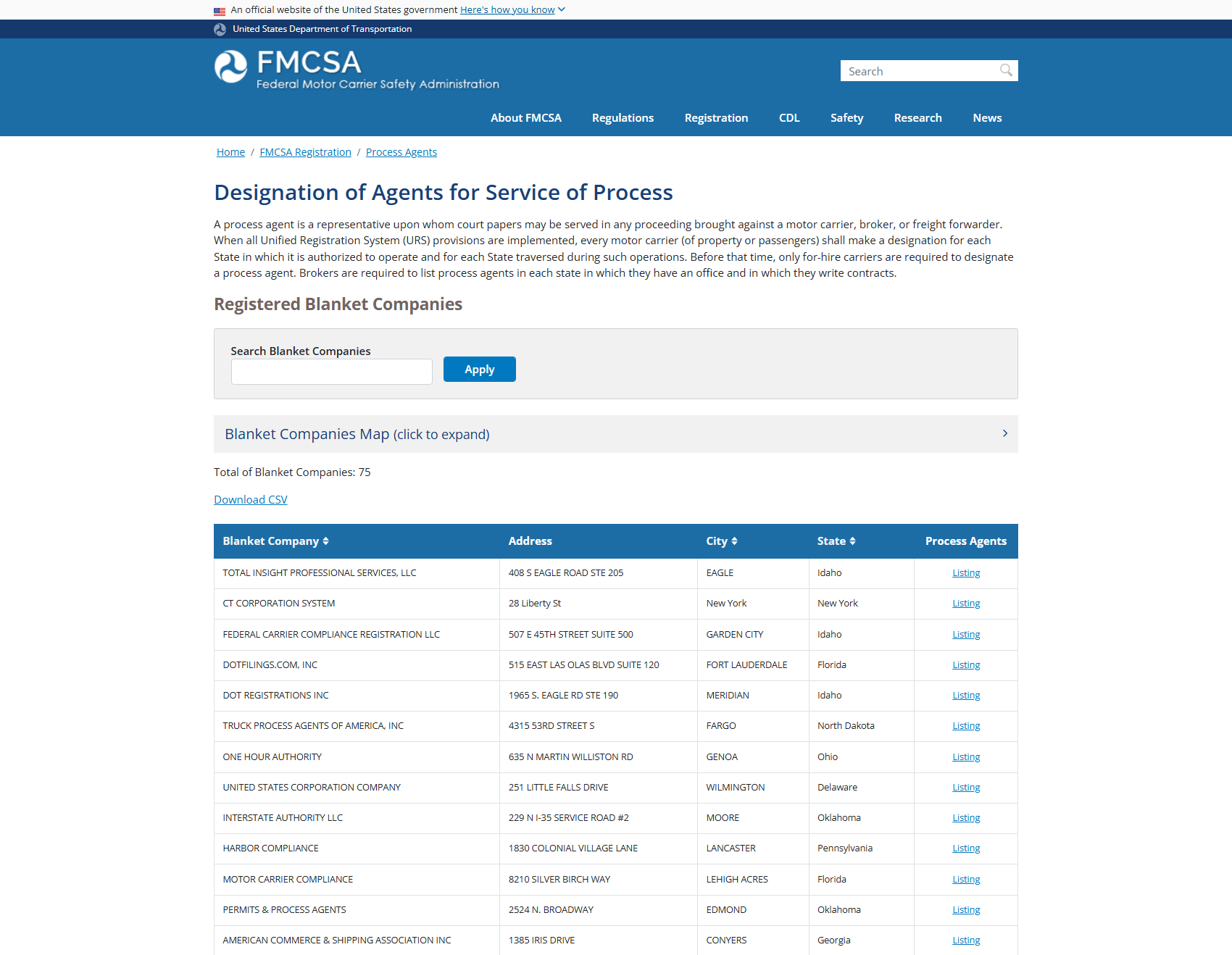
A few things worth knowing about that page:
- You can search by company name, sort by state, or hit Download CSV to get the entire list at once.
- The Listing link on each row shows you which agents that company has designated, state by state.
- At last check there were 75 registered blanket companies. That is the whole market, and being on that list is the credential that matters for this.
If a company is not on that FMCSA list, they are not a registered blanket company, and you should ask some pointed questions before you pay them anything.
What it costs
Usually $25 to $50, one time. That is the honest market rate for a blanket filing, and the filing itself takes minutes once you have paid.
Where it gets more expensive:
- Annual or monthly plans. Plenty of providers sell the BOC-3 as a subscription, sometimes $35 to $75 a year, sometimes bundled into a larger compliance package with UCR, MCS-150 reminders, and drug-program administration. That is not a scam by itself, as long as you know you are buying a service and not a required renewal.
- Authority packages. If somebody is charging you $600 to $2,000 to "set up your authority," the BOC-3 is in there, and so is the $300 MC fee, and so is a large markup on filling out free forms. We say the same thing in how to start a trucking company: you do not have to pay anybody thousands of dollars to file paperwork you can file yourself.
The realistic first-year compliance stack, in deadline order, is in permits and compliance 101.
Does it matter if the process agent is in my state?
No, and this trips up almost everybody.
Look at that FMCSA list again. The companies on it are headquartered in Idaho, New York, Florida, Oklahoma, Delaware, North Dakota. It does not matter where the company sits. What matters is that the company has designated an eligible agent in every state, and a registered blanket company by definition has.
So a Texas carrier can absolutely use a blanket company based in Idaho. When a Texas court needs to serve you, they serve that company's designated Texas agent, not their Idaho headquarters.
The rule underneath this is that the agent for a given state has to be a person or company actually resident or with an office in that state. Technically you could name individual agents state by state, and you could even name yourself in the state where you really do have an office. But then you would need an eligible agent lined up in all the others, and these filings go to FMCSA electronically through registered process agents anyway. Nobody does it the hard way. Pick a blanket company and move on.
One time, or every year?
The filing itself is one time. A BOC-3 has no expiration date. Once it is on file it stays on file, and there is no annual renewal the way UCR has one.
What you do have to watch:
- You need a new one if your process agent changes. Filing a new BOC-3 replaces the old one completely, it does not stack on top of it. So never file a second one "just to be safe" while you are still relying on the first.
- You need a new one if your legal name, ownership, or MC number changes. A new authority means a new BOC-3.
- You need to keep the relationship alive. If your agent resigns you or shuts down, your designation is gone even though you "filed it once in 2023." That is the lapse that gets authorities revoked.
- A recurring fee is not the same as a recurring requirement. If you are paying a yearly charge, you are paying for the agent to keep representing you, not for a filing FMCSA demands again.
How to check whether yours is actually on file
Do not assume. Pull your own record:
- FMCSA's Licensing and Insurance system (li-public.fmcsa.dot.gov) shows your authority status plus what is on file, including your BOC-3 and your insurance filings.
- Motus and SAFER show the same picture from a different angle. We walk through reading both, line by line, in how to read Motus and SAFER.
If you see active authority with no BOC-3 or no insurance on file, something is wrong right now, and it is worth a phone call today rather than next week.
The order this actually happens in
- Form the business, get your EIN, get your USDOT number.
- Apply for operating authority and pay the $300.
- Get your BOC-3 filed through a registered blanket company.
- Get your insurance bound so your insurer can transmit the BMC-91X.
- Wait out the 21-day protest period.
- Authority goes active. Now you can haul.
Steps 3 and 4 run at the same time as step 5, which is the part people waste. The protest period is free time if your filings are already sitting there waiting to count. If you are at step 2 or 3 right now, get your insurance application moving today so the filing is not the thing holding you up on day 21.
Start your insurance filing and activate your authority
This is general education for trucking operators, not legal advice and not a quote. Requirements change, and your situation may differ. The insurance filing side is ours, and we will tell you straight what it takes to get your MC number turned on.